
The Complete Football Route Tree: All Routes, Numbers & Strategies
Apr 01, 2021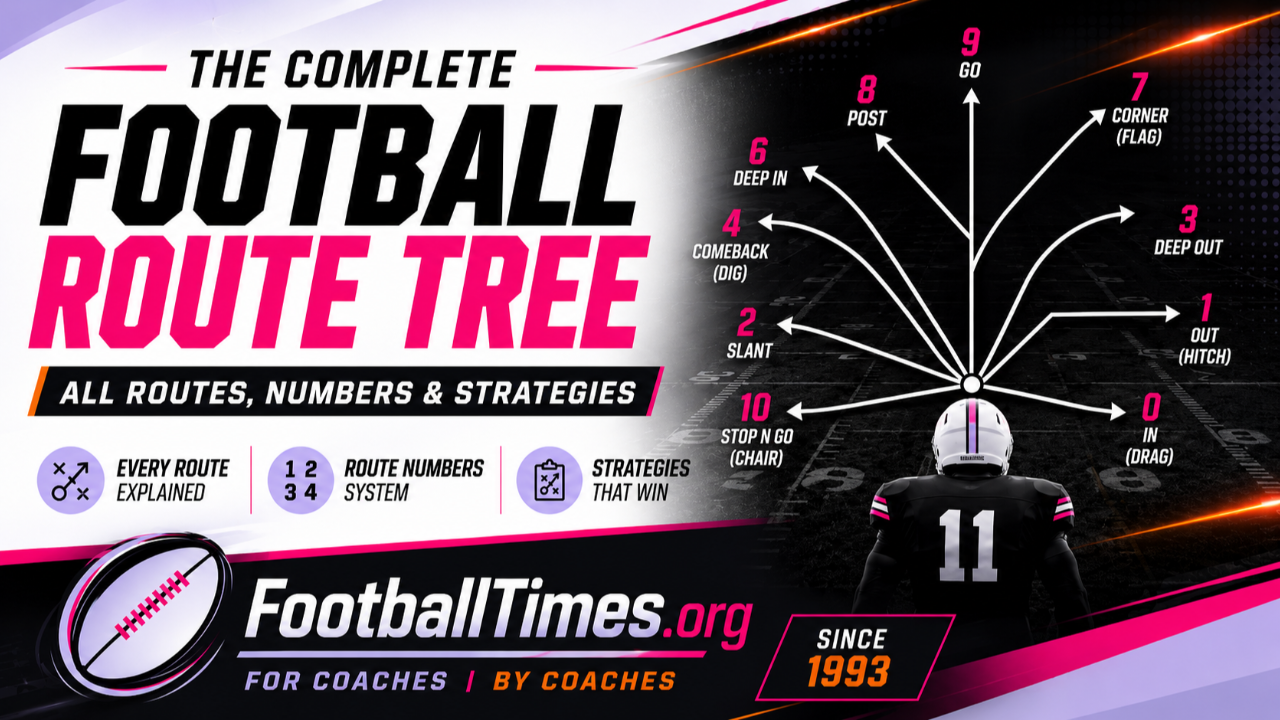
What Is a Route Tree in Football?
A route tree is a visual diagram showing all the receiver routes that can be run from a given position in football. It's also called a "passing tree" or "football routes tree" because it shows every route option available to wide receivers, running backs, and tight ends on a passing play.
The route tree is the foundation of every passing game in football. Whether you're playing in the NFL, college, high school, or backyard football, understanding routes is non-negotiable for offensive success.
In the standard route tree numbering system, odd numbered routes go to the outside, while even numbers go inside. At the college and pro level, players will have to know the numbers that represent each pattern. Plays are called like "689" where the three receivers each know their assigned number.
Football Routes Numbering System: How Routes Are Called
Understanding the route numbering system is critical for any player running routes at competitive levels. The numbering system provides shorthand so coaches can call plays without confusion.
| Route Number | Route Name | Route Depth | Direction | Primary Use |
|---|---|---|---|---|
| 0 | In / Drag | 3-5 yards | Inside | Quick routes, hot routes vs. blitz |
| 1 | Out / Hitch | 5 yards | Outside | Man coverage, horizontal stretch |
| 2 | Slant | 3 yards | Inside | Most used route, vs. press, vs. blitz |
| 3 | Deep Out | 10 yards | Outside | Intermediate route, stretch zone |
| 4 | Comeback / Dig | 10 yards | Inside | Cover 2 beater, prevent defense |
| 6 | Deep In | 10+ yards | Inside | Intermediate to deep, zone beater |
| 7 | Flag / Corner | Deep | Outside | Red zone, corner of endzone |
| 8 | Post | Deep | Inside | Most used deep route, all levels |
| 9 | Go / Streak / Fly | Deep | Straight | Speed advantage, tight coverage |
| 10 | Stop N Go / Chair | Variable | Variable | Shake off defender, pump fake |
How Football Routes Are Called: Backyard vs. Competitive Football
The way routes are communicated changes based on the level of play.
Backyard Football: In backyard football, the quarterback will usually call routes by name rather than number. Coaches may even draw them on their chest or the ground if someone doesn't know a route.
High School, College, and Pro Football: At competitive levels, coaches use the route numbering system exclusively. Players must memorize all route numbers and execute them on command during fast-paced game situations.
Wide Receiver Routes: The Foundation of the Passing Game
Wide receivers run the most routes in any offense. Understanding WR route trees is essential for any passing-oriented team.
How to Line Up as a Wide Receiver
Before you run any route, your alignment is critical. Defensive backs are trained to read receiver alignment. If you tip off your route by lining up differently, you lose your advantage.
Wide Receiver Alignment Rules:
- Always line up the same way, no matter what pattern you are running
- Don't give it away by lining up differently for short vs. deep routes
- Line up with your outside leg back (the leg closest to the sideline)
- Keep your inside leg forward (the leg closest to the offensive line)
- Maintain consistent stance from snap to snap
- Always look like you are getting the ball, even on routes not designed for you
Why Alignment Matters: Every little detail matters in football. Safeties have to rotate. DBs will turn. Linebackers will bite or freeze. If you always look the same, defenders can't predict your route. Run every pattern hard because defenders will screw up, fall, or become confused. If you run every route like your life depends on it, you will eventually get the ball.
Wide Receiver Stance and Leg Placement
Your stance determines how quickly you can cut. The route tree is designed so that you cut inside on your outside leg or cut outside on your inside leg.
As a wide receiver you have to line up with your outside leg back. That's the leg that you will cut on. It's perfect this way, don't try to change it.
The Biomechanics: When you take your first three steps, you cut hard on your outside foot. This allows you to make the quickest, sharpest, most unexpected cut to the inside. The cornerback won't have time to react. If you notice, NFL receivers always line up with their inside leg forward (the inside leg is the one closest to the offensive line).

Most Common Wide Receiver Routes Explained
0. In Route (Also Called Drag)
Go up the field then cut in toward the center at a sharp angle. On the opposite side, reverse it. Sometimes this is also known as a Drag.
0. Dig Route
Run up the field about 3 yards hard, then come back at a 45 degree angle toward the QB. Square up with straight legs. Find an opening and sit there.
1. Out Route
Go up the field about 5 yards, then take a sharp Out towards the sideline. Make sure it is a hard 90 degree angle so the DB cannot get to you. The QB will have you wide open.
2. Slant Route
The slant is the most famous and most used short route in all of football. As soon as the ball is snapped, take 3 hard steps forward then an angled path towards the center. You will get the ball quickly, before you reach the end of your route. The QB will most likely throw it while you are still running straight, so be ready to catch.
When to Run a Slant: This is a great pattern if the defense is blitzing. Try to get behind the linebackers.
Proper Slant Technique: Line up with your inside foot forward and outside foot back. When you take your three steps, cut hard on your outside foot. This allows you to make the quickest, sharpest, most unexpected cut to the inside.
3. Deep Out Route
Similar to the out, except run at 10 yards. Go straight up the field hard like a Go route, then turn very hard, 90 degrees, to the outside.
4. Comeback Route (Also Called Deep Dig or Deep In)
Go up the field, then quickly comeback to the QB. He will hit you on your way back. May also be modified to a "Stop", "Dig" or "Hitch" which means rather than comeback, you just stop and wait for the ball.
6. Deep In Route (Also Called Deep Comeback)
Go up 10 yards, then drag across the field. You can do this in front of or behind the linebackers. You can also stop and Comeback to the QB, finding an empty area in the defense.
7. Flag Route (Also Called Corner or Chair or Post Corner)
Run down the field hard. Fake a step in toward a Post route (sell it well), then take another turn for the corner pylon in the back of the endzone. You basically fake a deep Post, then turn for the corner of the endzone. It can be run from either side to either back pylon depending on where you line up.
8. Post Route
Post is the most famous and most used deep route in football. Go up the field, then cut to the goal Post. This is usually a deep play for a lot of yards. The post being the 'goal post'. If no post exists, go to the center of the field.
9. Go Route (Also Called Streak or Fly)
Just keep running down the field fast. Outrun your defender. Especially useful if your defender is playing you very tight. Make sure the fastest receiver on your team gets to run this route. It works very well.
Less Common Wide Receiver Routes
10. Stop N Go Route (Also Called Chair)
Go up the field a few yards, then turn around as if you are getting the ball. The QB will pump fake. Then take off down the field. Your defender will be confused and fall down.
12. Short Post Route
Similar to the post, but shorter. It's in between the Slant and the Post. When defense is in cover 2 (two safeties), one will play short, one deep. This pattern is designed to get the receiver in the empty area in between. It works well especially if two receivers team up on the same side, one stays short, the other Streaks. Also works if the DBs and Safeties are playing short and deep zone.
Running Back Routes: The Third Dimension of the Passing Game
Running backs run many of the same routes as wide receivers, with some position-specific variations.
Common RB Routes:
- Flat Route: Release to the sideline at 3-5 yards. Quick pass, escape blitz
- Swing Route: Arc around the QB, get to the sideline. Great in space, one cut to go
- Wheel Route: First go deep like a Go route, then arc back sideline. Beats zone, creates space
- Checkdown Route: Short in-breaking route, outlet for QB pressure
- Short Out Route: 4-5 yards out. Quick cutoff route vs. zone
Running backs are often the most reliable receivers on the field. When the QB is under pressure, a running back on a checkdown or flat route is often the difference between a sack and a gain.
Tight End Routes: The Hybrid Pass Catchers
Tight ends run routes that blend WR and RB patterns. They can attack deep coverage like a receiver while also handling underneath zone routes like a back.
Common TE Routes:
- Seam Route: Straight up the field, split the safeties. Beats Cover 2
- Corner Route: Similar to WR flag route, goes to corner of endzone
- Dig Route: 10-12 yards, same as WR version
- In Route / Drag: Underneath drag across middle
- Y-Cross: Start at TE position, crack block first, then release across formation
Route Tree Strategy: Choosing the Right Route Against Different Defenses
Understanding when to run each route is what separates good receivers from great ones.
| Defensive Coverage | Best Route Choices | Why This Works |
|---|---|---|
| DB playing way off / soft coverage | Quick Slant, In route, quick throw | QB gets ball out fast before DB can close |
| DB playing tight / press coverage | Post, Go route, Deep Slant | Create separation vertically, outrun DB |
| DB gives you inside, closes outside | Slant, In, Quick Out | Take what the defense allows |
| DB opens up, allows outside | Out, Go, Hitch, Wheel (RB) | Attack the weakness the DB shows |
| Man coverage with blitz | Slant, Quick Out, Checkdown | Get open quickly before pressure arrives |
| Zone coverage / Cover 2 | Short Post, Seam, Dig, Drag | Exploit gaps between zone defenders |
| Cover 3 zones | Out, Deep Out, Corner, Comeback | Attack soft spots between three deep zones |
| Prevent defense (red zone) | Corner, Post, Flag, Dig | Exploit safety depth, work sidelines |
The Mental Game: Running Routes With Intent
The difference between an average receiver and a great one isn't just talent. It's effort on every single play.
Make sure you run every pattern hard, as if you are going to get the ball on every down. You have to sell it. Every little detail matters.
Safeties have to rotate. DBs will turn. Linebackers will bite or freeze. If you run every route like it's the scoring play of the game, you force the defense to respect you. Even if the play isn't designed for you to get the ball, your effort helps the offense by moving safeties and opening up throwing lanes for your teammates.
Football Passing Tree FAQ
What is the passing tree in football?
The passing tree is a visual diagram showing all the receiver routes available in an offense. It's also called the "route tree" and shows how routes are numbered for easy play calling.
What is the most used route in football?
The slant is the most used short route, while the post is the most used deep route. Together, these two routes form the backbone of most offenses.
What is the easiest route to run?
The slant is widely considered the easiest route because it requires only 3 hard steps forward and a sharp cut. It's also the quickest route to the ball.
What routes do running backs run?
Running backs run flat, swing, wheel, and checkdown routes primarily. They use many of the same routes as receivers but adapted for their position.
How do you read the route tree numbers?
In most numbering systems: odd numbers go outside, even numbers go inside. Route 2 is a slant (inside), Route 1 is an out (outside), Route 8 is a post (inside deep).
Do all offenses use the same route tree?
Most offenses use similar numbering systems, but specific route depths and details can vary by coach and system. The core routes (slant, post, out, in) are universal.
How long does it take to master the route tree?
Most receivers take a full season to master all routes. The routes themselves are simple, but executing them with sharp cuts, proper timing, and reading the defense takes thousands of reps.
Summary: Master Football Routes and the Passing Tree
The football route tree is the foundation of every passing game, from backyard football to the NFL. Whether you're a wide receiver, running back, or tight end, mastering routes is essential. The key is consistent alignment, sharp footwork, maximum effort on every play, and reading the defense to choose the best route for each coverage.
If you want to learn how to use routes in a game and scheme them properly, grab our two books from Amazon. Get our Flag and Tackle coaching books!
Overall WR Route Strategy
If the defender is playing way off you, run a quick Slant. Your quarterback should recognize this. You can also stay put and let him quickly throw it to you.
If the defender is playing very tight, go for a Post, Go, or deep Slant.
You should be able to tell what route will work based on how the defense lines up. If you notice the defensive back giving you the inside route, take it with a Slant or In route. If the defender is opened up and giving you the outside, go for an Out, Go, or Hitch.
Below is another look at common route names, including some running back routes.
Football Wide Receiver Pattern Names

Running Back Route Tree Patterns
If you want to learn how to use these routes in a game and scheme them properly, grab our Flag and Tackle coaching books from Amazon.