
What Is Safer For Knee Injuries Real Grass OR Artificial Turf?
Jul 30, 2026
Natural Grass vs. Artificial Turf: What Does the Research Say About Knee Injuries?
Few debates in sports medicine generate as much passion as the question of whether artificial turf increases the risk of knee injuries compared to natural grass. Athletes, coaches, team owners, and medical professionals all have a stake in the answer. With artificial turf installations growing rapidly at every level of competition, from youth leagues to professional stadiums, understanding the relationship between playing surface and injury risk has never been more important.
The answer, it turns out, is not straightforward. A growing body of research suggests that the relationship between playing surface and knee injury risk depends heavily on the sport being played, the level of competition, the generation of turf being used, and even the type of cleats worn by the athlete. Anyone hoping for a clean verdict of "grass good, turf bad" will find that the evidence refuses to cooperate.
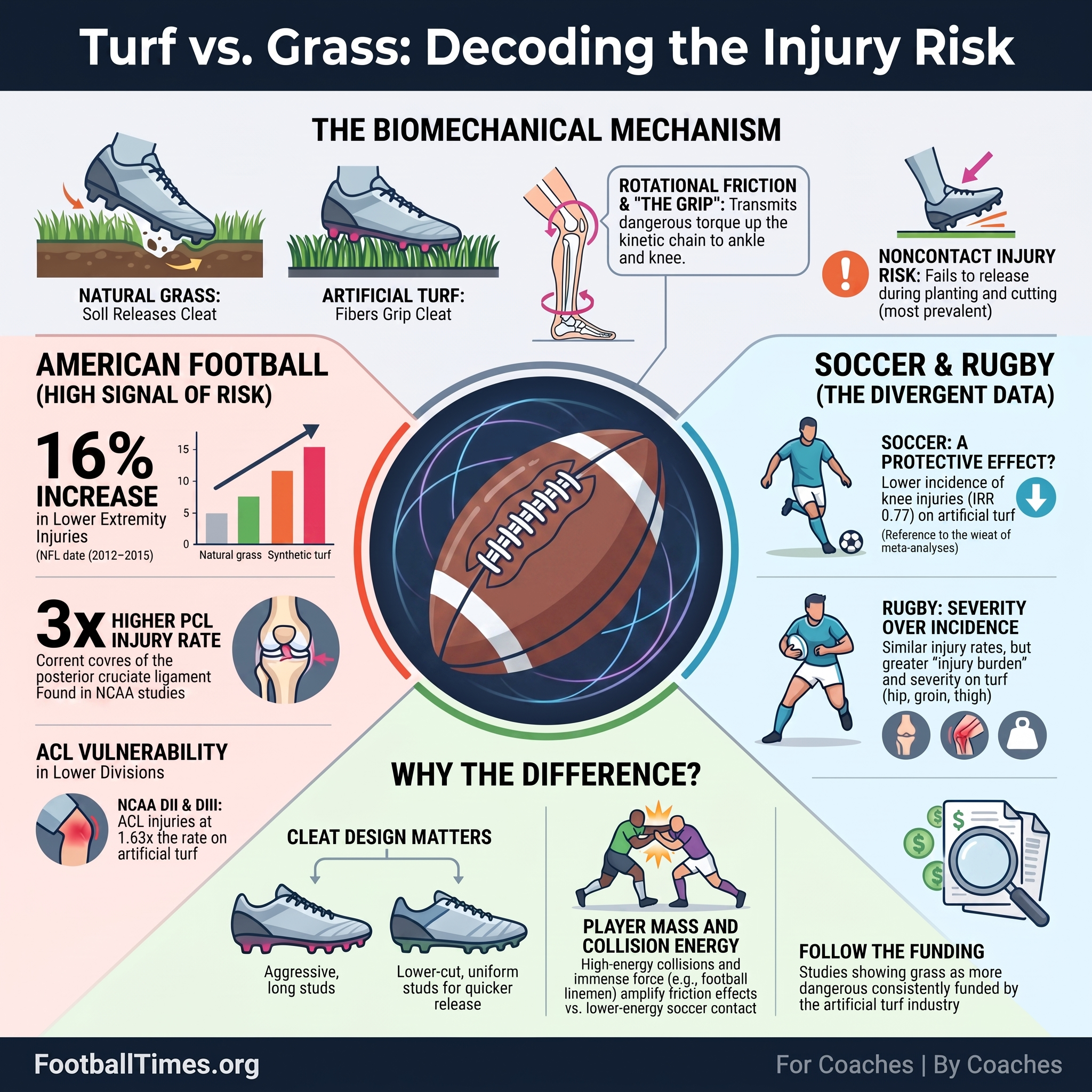
Infographic Summary:
A Brief History of Artificial Turf
Artificial turf first appeared in the 1960s, and early versions were essentially carpets of short nylon fibers laid over concrete or asphalt. These first-generation surfaces were notoriously hard and unforgiving, and athletes quickly noticed an uptick in injuries. Second-generation surfaces introduced sand infill to provide some cushioning, but they still behaved very differently from natural grass.
The modern era of artificial turf began with third-generation surfaces, which feature longer synthetic grass-like fibers embedded in granules of sand, rubber, and silica. These surfaces were specifically designed to mimic the playing characteristics of natural grass. While they represent a significant improvement over their predecessors, the question of whether they are truly equivalent to grass in terms of injury risk remains open. That distinction matters, because a great deal of the older injury data was collected on surfaces that no groundskeeper would install today.
The Biomechanical Theory
Before diving into the epidemiological data, it helps to understand the biomechanical theory that underpins much of this research. When an athlete plants a foot and changes direction, the cleat must eventually release from the surface to allow the body to rotate. On natural grass, the soil gives way relatively easily, allowing the cleat to release. On artificial turf, the synthetic fibers and infill material tend to grip the cleat more tightly, creating higher rotational friction at the shoe-surface interface.
This increased friction means that more torque is transmitted up through the ankle and knee rather than being dissipated at the ground. The theory holds that this additional loading on the lower extremity joints increases the risk of ligament injuries, particularly to the anterior cruciate ligament (ACL), which is vulnerable to rotational and valgus forces. Research in the NFL has provided epidemiological confirmation of this biomechanical hypothesis, showing that synthetic turf produced a 16% increase in lower extremity injuries per play compared to natural grass, with the effect being notably stronger for noncontact and surface-contact injuries. [1]
American Football: A Clear Signal
The evidence linking artificial turf to increased knee injury risk is strongest in American football. A landmark study of NFL games from 2012 to 2016 found that play on synthetic turf resulted in a statistically significant 16% increase in lower extremity injuries per play (IRR 1.16; 95% CI, 1.10 to 1.23). When the analysis was restricted to noncontact and surface-contact injuries, the effect was even more pronounced, with incidence rate ratios ranging from 1.20 to 2.03. This finding is particularly important because noncontact injuries are the ones most likely to be influenced by the playing surface rather than by collisions between players. [1]
At the collegiate level, a study of over 3 million athlete-exposures in NCAA football from 2004 to 2014 found that athletes competing on artificial turf experienced posterior cruciate ligament (PCL) injuries at nearly three times the rate of those playing on grass (RR 2.94; 95% CI, 1.61 to 5.68). When the data were broken down by division, athletes in lower NCAA divisions (II and III) experienced ACL injuries at 1.63 times the rate on artificial turf compared to grass. Interestingly, no significant difference was found in the rate of medial collateral ligament (MCL) or meniscal injuries between surfaces. [2]
A systematic review of ACL injuries across sports confirmed that every study finding an increased risk of ACL injury on synthetic surfaces involved an American football cohort. This consistency across multiple studies, levels of competition, and generations of turf makes a compelling case that something about the combination of football and artificial turf creates a uniquely hazardous environment for the knee. [3]
Soccer: A Different Story
In striking contrast to football, the data from soccer (association football) tell a very different story. A large systematic review and meta-analysis that pooled data from multiple studies found that the incidence of knee injuries was actually lower on artificial turf (14 studies: IRR 0.77; 95% CI, 0.64 to 0.92). The same analysis found lower rates of pelvis and thigh injuries and muscle strains on artificial turf as well. No soccer cohort has demonstrated an increased risk of ACL injury on synthetic surfaces. [6]
A six-year prospective study of collegiate men's soccer provided further support for these findings. The study, which evaluated 765 games split nearly evenly between FieldTurf and natural grass, found a significantly lower total injury incidence on FieldTurf (7.1 vs. 11.8 per 10 team games; P < .0001). No significant difference in knee injuries was observed between surfaces, with most knee injuries on both surfaces being patellar tendinopathies and MCL injuries. [8]
In youth soccer, the evidence is similarly reassuring. A 2016 study found that players who suffered a lower-extremity injury were actually 2.83 times more likely to have been playing on a grass surface and 2.40 times more likely to have worn cleats on grass during practice compared to uninjured players. [7]
One important caveat tempers the soccer story: many of the subgroup analyses in the soccer meta-analysis had wide confidence intervals and high uncertainty, so the apparent protective effect of artificial turf in soccer should be interpreted with some caution rather than treated as settled fact. [6]
Rugby: Severity Matters
Research from men's professional rugby union in England (2013 to 2019) added another dimension to the discussion by focusing not just on injury incidence but also on injury severity and burden. The study found greater mean severity and burden of lower limb injuries on artificial surfaces, particularly at the hip and groin, posterior thigh, and foot and toe. The authors attributed this to greater torque and rotational stiffness experienced on artificial surfaces, with boot-surface interaction playing a key role in how force is dissipated along the lower limb kinetic chain. Without adequate force dissipation, greater rotational and shear forces may be applied to lower limb tissues, potentially exceeding the capacity of those structures to a greater extent than on grass. [9]
The rugby data are a useful reminder that "how often" and "how badly" are different questions. A surface can produce a similar number of injuries while still making the injuries that do occur more damaging.
Why the Discrepancy Between Sports?
The fact that artificial turf appears to increase knee injury risk in football but not in soccer is one of the most intriguing findings in this body of research. Several explanations have been proposed.
First, cleat design differs substantially between the two sports. Football cleats tend to have longer, more aggressive studs designed for maximum traction during explosive movements. Soccer cleats are generally lower-cut with shorter, more uniform studs that allow for quicker release from the surface. Research has shown that shoes with longer irregular cleats placed at the peripheral margin of the sole are associated with a higher risk of ACL injuries compared to flat, soccer-style cleats. [3]
Second, the nature of contact differs between sports. Football involves frequent high-energy collisions in which players are often struck while their feet are planted, creating combined loading from both the surface and the impact. Soccer involves less frequent and generally lower-energy contact.
Third, player size and the forces generated during play differ considerably. Football linemen, for example, generate enormous forces during blocking and tackling that are transmitted through planted feet, potentially amplifying the effect of increased shoe-surface friction.
The Role of Industry Funding
One finding from the literature deserves special attention. A comprehensive systematic review of 53 studies noted that only a few articles reported a higher overall injury rate on natural grass compared to artificial turf, and all of these studies received financial support from the artificial turf industry. While industry-funded research is not inherently invalid, this pattern underscores the importance of considering funding sources when evaluating the evidence, especially when a study's conclusions run counter to the broader body of literature. [4]
The Evolution of Turf Technology
It is worth noting that the evidence base spans multiple generations of artificial turf. An earlier review observed that many studies cited higher overall injury rates on first- and second-generation artificial turf compared with natural grass, but the rate of injury on third-generation turf appeared comparable to natural grass. This suggests that turf technology has improved meaningfully over time, though it has not entirely eliminated the differences in injury risk, particularly in football. [5]
What We Know and What We Do Not
The current state of the evidence can be summarized as follows. In American football, artificial turf is associated with higher rates of certain knee injuries, particularly ACL and PCL injuries, with the effect being most pronounced during competition and for noncontact mechanisms. In soccer, knee injury rates appear similar or even lower on artificial turf compared to natural grass. In rugby, artificial surfaces may increase the severity and burden of lower limb injuries even if overall incidence is similar. Across sports, foot and ankle injuries are more consistently elevated on artificial turf. The biomechanical mechanism of increased shoe-surface friction and reduced cleat release is well-supported and likely explains much of the observed effect.
What remains less clear is exactly how to mitigate these risks. Cleat design, surface maintenance, infill composition, and environmental conditions such as temperature and moisture all likely play a role, but the optimal combination of these factors has not been definitively established.
Conclusion
The question of whether artificial turf increases knee injury risk does not have a simple yes-or-no answer. The evidence points to a complex interaction between the playing surface, the sport, the level of competition, the footwear, and the individual athlete. For football players and their medical teams, the data provide legitimate cause for concern and should inform decisions about surface selection, cleat choice, and training practices. For soccer players, the current evidence is more reassuring, though continued surveillance is warranted as turf technology and athletic demands continue to evolve.
What is clear is that playing surfaces are not neutral. They are an active participant in the biomechanics of sport, and their role in injury causation deserves ongoing attention from researchers, clinicians, and the organizations that govern athletic competition.
This article synthesizes findings from NFL epidemiological data, NCAA football injury surveillance, systematic reviews of ACL risk across sports, soccer-specific meta-analyses, AAP guidance on youth soccer injuries, a prospective collegiate soccer study, professional rugby data, and an earlier comprehensive review of playing surfaces. [1-9] The industry funding observation comes specifically from the Gould et al. systematic review. [4]
Would you like to explore the specific role of cleat design and stud configuration in modulating ACL injury risk across different playing surfaces?
References
1. Higher Rates of Lower Extremity Injury on Synthetic Turf Compared With Natural Turf Among National Football League Athletes: Epidemiologic Confirmation of a Biomechanical Hypothesis. The American Journal of Sports Medicine. 2019. Mack CD, Hershman EB, Anderson RB, et al.
2. Incidence of Knee Injuries on Artificial Turf Versus Natural Grass in National Collegiate Athletic Association American Football: 2004-2005 Through 2013-2014 Seasons. The American Journal of Sports Medicine. 2019. Loughran GJ, Vulpis CT, Murphy JP, et al.
3. Risk of Anterior Cruciate Ligament Injury in Athletes on Synthetic Playing Surfaces: A Systematic Review. The American Journal of Sports Medicine. 2015. Balazs GC, Pavey GJ, Brelin AM, et al.
4. Lower Extremity Injury Rates on Artificial Turf Versus Natural Grass Playing Surfaces: A Systematic Review. The American Journal of Sports Medicine. 2023. Gould HP, Lostetter SJ, Samuelson ER, Guyton GP.
5. The Effect of Playing Surface on Injury Rate: A Review of the Current Literature. Sports Medicine. 2010. Dragoo JL, Braun HJ.
6. Incidence of Football Injuries Sustained on Artificial Turf Compared to Grass and Other Playing Surfaces: A Systematic Review and Meta-Analysis. EClinicalMedicine. 2023. Kuitunen I, Immonen V, Pakarinen O, Mattila VM, Ponkilainen VT.
7. Soccer Injuries in Children and Adolescents. Pediatrics. 2019. Watson A, Mjaanes JM.
8. Incidence, Mechanisms, and Severity of Match-Related Collegiate Men's Soccer Injuries on FieldTurf and Natural Grass Surfaces: A 6-Year Prospective Study. The American Journal of Sports Medicine. 2017. Meyers MC.
9. Influence of playing surface on match injury risk in men's professional rugby union in England (2013-2019). Scandinavian Journal of Medicine & Science in Sports. 2022. Robertson CM, Williams S, West SW, et al.